


European Degree Label: A New European Instrument for Joint Study Programmes
September 3, 2026
One of the key topics currently under discussion at European level is the European Degree Label. This instrument is intended not only to stimulate cooperation between higher education institutions in the delivery of study programmes, but also to promote common approaches to quality assurance and the evaluation of study programmes.
The European Degree Label was presented at an expert event held under the auspices of the Polish Accreditation Committee (PKA) in Warsaw on 31 August 2026.
The European Degree Label is open to higher education institutions that meet the established European criteria. These criteria cover, for example, the joint organisation and delivery of study programmes, quality assurance, student mobility, interdisciplinarity, multilingualism, inclusion, and environmental sustainability.
The assessment is intended to rely, to the greatest extent possible, on existing quality assurance procedures and documentation, thereby avoiding additional administrative burdens and duplicate assessments.
The National Accreditation Bureau will continue to monitor developments in this area and provide Czech higher education institutions with information and support in navigating the opportunities offered by the European Degree Label.
More information on the European Degree Label can be found here.
For those interested in further information on the European Degree Label, a second webinar organised by the European Commission (support from PPMI/part of the Verian Group and ICF). will take place on 24 September 2026 from 10:30 to 12:00 CET online via MS Teams. The webinar will focus in particular on higher education institutions considering applying for the European Degree Label for their joint study programmes. Participants will receive the latest updates, learn more about the application process and the preparation of the self-assessment report, and hear about the experiences of two joint programmes that were awarded the label in July 2026. The session will conclude with a Q&A. Registration is available here.
NAB continues to hold the prestigous NCFMEA comparability status
July 15, 2026
After nearly a year-long evaluation process culminating in a public hearing in front of the U.S. National Committee on Foreign Medical Education and Accreditation (NCFMEA), the National Accreditation Bureau for Higher Education successfully maintained its prestigious certification, which allows U.S. citizens to obtain federal loans to study General Medicine in the Czech Republic. The comparability decision is granted only to countries whose quality requirements for medical schools meet the high standards applied in the U.S., and it significantly contributes to the standing of Czech medical schools on the international level. Professors David Sedmera and Otomar Kittnar of Charles University contributed indespensable expertise in support of the evaluation process.
Seminar on the topic of cooperation between tertiary professional schools and higher education institutions
July 8, 2026
The National Accreditation Bureau for Higher Education is organizing a seminar on September 22, 2026, dedicated to cooperation between tertiary professional schools and higher education institutions. The program will feature presentations of selected examples of existing best practices as well as a panel discussion on the possibilities and limitations of future cooperation between the two sectors of tertiary education. The seminar is intended for representatives of tertiary professional schools and higher education institutions; registration will open on August 1, 2026. The preliminary program is available on the Conferences and Events page.
Strategic Plan of NAB for 2026-2029
July 7, 2026
The Strategic Plan for 2026-2029 was published on the Strategic and Policy Documents page.
The National Accreditation Bureau enters its second year of operation
July 1, 2026
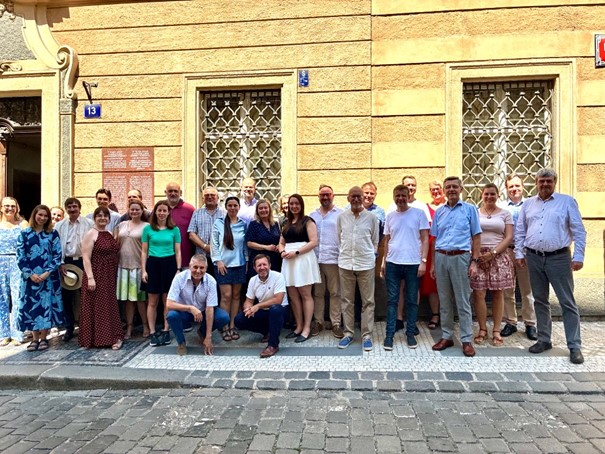
One year after its establishment, the National Accreditation Bureau for Higher Education is taking stock of the accomplishment of an extensive institutional transformation, which included a significant expansion of its scope to include new areas of responsibility. Through the joint efforts of all bodies, office staff, and evaluators, the following key achievements were made over the past twelve months:
- preparation of a draft of new standards for the accreditation of higher education study programs and for institutional accreditation,
- streamlining of the work of evaluation committees in the accreditation of higher education study programs,
- incorporation of site visits as a standard part of the assessment of newly introduced study programs,
- assuming of responsibility for the accreditation of educational programs in tertiary professional education,
- organization of the first international seminar on the topic of quality assurance in higher education,
- commencement of the preparation of first thematic analyses focused on the development of quality in tertiary education,
- approval of the strategic plan for NAB’s activities through 2029.
The first year of NAB’s existence was thus primarily a period of intensive work that laid a solid foundation for the further development of the quality assurance system for higher education institutions and tertiary professional schools in the Czech Republic.
European Commission Has Published Operational Guide for the Joint European Degree Label
June 23, 2026
The European Commission has published the Operational Guide for the Joint European Degree Label (EDL), offering practical guidance for higher education institutions participating in the pilot implementation of this initiative.
The European Degree Label (EDL) is a European quality label awarded to joint programmes that meet a common set of criteria relating to programme organisation, international cooperation, and the European dimension of higher education. It is neither a new academic qualification nor a new form of accreditation. Rather, it is a voluntary label intended to support the development of high-quality joint European programmes and to strengthen their recognition and visibility.
The newly published Operational Guide sets out the eligibility requirements for programmes, the assessment framework, and the procedures for awarding the European Degree Label. The accompanying annexes include a recommended self-assessment report template, an evidence portfolio, a glossary of key terms, and certificate templates.
The guide may be of interest not only to institutions participating in the European Degree Label pilot, but also to higher education institutions that are developing or delivering joint programmes in a European context.
Further information on the European Degree initiative and its future development is available on the European Commission’s dedicated webpage on the Joint European Degree.
CEENQA Celebrated the 25th Anniversary of Its Establishment with a Conference on Artificial Intelligence in Higher Education Quality Assurance
June 17, 2026
In 2026, the Central and Eastern European Network of Quality Assurance Agencies in Higher Education (CEENQA) celebrated the 25th anniversary of its establishment. The anniversary conference focused on the use of artificial intelligence in external quality assurance processes in higher education. The programme explored both the opportunities and the challenges associated with the integration of AI tools into the work of quality assurance agencies, including their application in data analysis, decision-making support, and the digitalisation of evaluation procedures. Particular attention was also paid to the need to maintain transparency, uphold ethical principles, and preserve expert human judgement in the use of these technologies.
As part of the anniversary events, the CEENQA General Assembly reviewed the network’s activities, discussed organisational matters, and elected new leadership for the upcoming term. Simona Lache was elected President of CEENQA, while Lasha Margishvili was elected Vice-President. The General Assembly also elected new members of the Board and approved the admission of the National Quality Assurance Agency for Education (NQAAE) of Uzbekistan as CEENQA’s newest member.
CEENQA is an international network bringing together quality assurance agencies in higher education from Central and Eastern Europe. Its mission is to foster cooperation among member organisations, facilitate the exchange of experience and good practice, and contribute to the development of quality assurance systems within the European Higher Education Area (EHEA). The former Czech Accreditation Commission was one of the founding members of the network, then operating under the name CEEN, and one of the network’s first presidents was Professor Milan Sojka, who at the time served as Vice-Chair of the Czech Accreditation Commission. The National Accreditation Bureau for Higher Education (NAB) has been a member of CEENQA since 2016.
The NAB Chair at the Conference on Quality Assurance in Higher Education
28 May 2026
At the annual conference Quality Assessment of Higher Education Institutions in Telč, Prof. Jaroslav Miller, Chair of the National Accreditation Bureau for Higher Education, presented the priorities for the following four-year period: institutional consolidation of the bureau, development of quality culture in tertiary education, strengthening transparency and trust among stakeholders, and international engagement. The presentation is available on the conference website.
ENQA Members´ Forum
May 21, 2026
Revision of the ESG was one of the main topics of the ENQA Members´ Forum, which took place on April 22–24, 2026, in Budapest, with representatives from NAB in attendance. The revision of the standards is already at a very advanced stage; the entire two-year process, in which ENQA representatives are actively involved, is expected to conclude with the adoption of the final document in May 2027. The revised ESG will take into account some recent trends in higher education (such as artificial intelligence), but will also strengthen the emphasis on the professionalism and integrity of quality assurance agencies as well as the transparency of their activities. The theme of building trust in quality assurance of higher education was a common thread throughout the forum, and significant attention was also paid to phenomena that undermine trust: fraud, corruption, and the so-called “degree mills.” Despite robust quality assurance systems and intensive international cooperation, these phenomena remain widespread, and combating them requires institutionalized joint efforts at the European level, which are concentrated within the ETINED platform.
International Seminar on Alignment with the ESG
March 17, 2026
Is the Czech national quality assurance system for higher education, following the amendment to the Higher Education Act, sufficiently aligned with the ESG for the NAB to become a full member of ENQA and be listed in EQAR? This question was addressed by participants at a seminar with international attendance. The aim of the event, organized by NAB, was to review developments in the area of key quality assurance priorities since 2021, when the National Action Plan for the Development of Quality Assurance in the Czech Republic was created as part of the Erasmus+ SEQA-ESG project. Stakeholders from the higher education institutions, students, and NAB expert evaluators discussed the alignment of Czech legislation and NAB activities with the ESG requirements, which represent generally accepted and applied quality assurance standards in the European context. The seminar also provided participants from higher education institutions, the Ministry of Education, and the employer sector with a unique opportunity to learn from the perspectives of representatives from the European organizations ENQA and EQAR, who shared their experiences with the development of quality assurance systems in a broader international context. Full integration into these European structures, based on alignment with the ESG, remains a long-term priority for NAB.
Presentations
- What has the National Accreditation Bureau ever done for you ?
- Czech Higher Education within the European Area of Quality Assurance
- Student Involvement in Quality Assurance at Higher Education Institutions in the Czech Republic
- Reflections on Developments in Quality Assurance of Czech HEIs
- The importance of quality assurance at European and national level
- Quality Assurance in the European Higher Education Area
Transformation of NAB
July 1, 2025
The National Accreditation Bureau for Higher Education (Národní akreditační úřad pro vysoké školství), established on September 1, 2016, by Act No. 111/1998 Coll., on Higher Education Institutions and on Amendments and Supplements to Other Acts (the Higher Education Act), as amended, transforms into the National Accreditation Bureau for Higher Education (Národní akreditační úřad pro terciární vzdělávání) as of July 1, 2025.
The National Accreditation Bureau for Higher Education (NAB) is a legal entity under public law established by the Higher Education Act. Its statutory body is its chairperson, Prof. Mgr. Jaroslav Miller, M.A., Ph.D.
Headquarters of the National Accreditation Bureau for Higher Education:
U Lužického semináře
13 118 00 Prague 1
Contact information for correspondence:
Email address: This email address is being protected from spambots. You need JavaScript enabled to view it.
Data box ID: k9z3e3y
The website will be continuously updated and expanded.